
Close
CFRPSAIL | Centre for Research in Political Sciences and International Law

Introduction:
When we hear the word “nationalism,” most of us think of flags, anthems, and people cheering for their country during a football match or an Olympic event. But nationalism is much bigger than that. It is an idea, a feeling, and sometimes even a political movement. At its core, nationalism is the belief that people who share a common language, culture, history, or land belong together as one nation, and that this nation deserves its own recognition, respect, and often its own independent state.
This assignment looks at what nationalism actually means, where it came from, the different forms it takes, and why it has been both a force for good and a cause of serious harm throughout history. By the end, the goal is to understand nationalism not as a simple “good” or “bad” idea, but as a powerful force that depends heavily on how it is used.
What Exactly Is Nationalism?
In simple terms, nationalism is the feeling of pride and loyalty a person has toward their nation. A “nation” here does not just mean a country in the legal sense. It usually refers to a group of people who feel connected through shared things like language, religion, traditions, history, or ethnicity. Nationalism turns that shared identity into a political idea: the belief that this group of people should have control over their own affairs, usually through their own state or government.
It is worth separating two words that often get mixed up: patriotism and nationalism. Patriotism is generally love for one’s country, its people, and its values, without necessarily thinking it is better than everyone else. Nationalism goes a step further. It often includes the idea that one’s own nation is special or even superior, and that its interests should come before everything else, sometimes even before basic fairness to other groups. This difference matters a lot, because it explains why nationalism can inspire unity in one situation and division or conflict in another.
A Short History of Nationalism:
Nationalism as we understand it today is actually a fairly modern idea. For most of human history, people were more loyal to their local village, their religion, or their king or emperor than to a “nation” in the way we think of it now. Large empires like the Roman Empire or the Ottoman Empire ruled over many different ethnic and language groups without expecting them all to feel like one single nation.
Historians often trace modern nationalism back to Europe in the late 1700s and 1800s. Two major events pushed this idea forward. The first was the American Revolution, where American colonists rejected British rule and built a new identity as “Americans.” The second, and arguably more influential, was the French Revolution. The French Revolution introduced the idea that power belongs to “the people” rather than to a king, and that the people who share the French language and culture form one unified French nation. This idea spread quickly across Europe.
Through the 1800s, nationalism became the driving force behind major changes, including the unification of Italy and Germany, both of which were previously divided into many small states. In the 1900s, nationalism played a huge role in the two World Wars and later fueled independence movements across Asia, Africa, and the Middle East, as colonized peoples used nationalist ideas to demand freedom from European colonial rulers.
Different Types of Nationalism:
Nationalism is not one single thing. Scholars usually break it down into a few different categories, and understanding these helps explain why nationalism can look so different from one country to another.
Why Nationalism Can Be a Positive Force:
Nationalism is often blamed for wars and division, but it has also done a lot of good throughout history. It can be a powerful, positive force under the right conditions.
Why Nationalism Can Be a Dangerous Force:
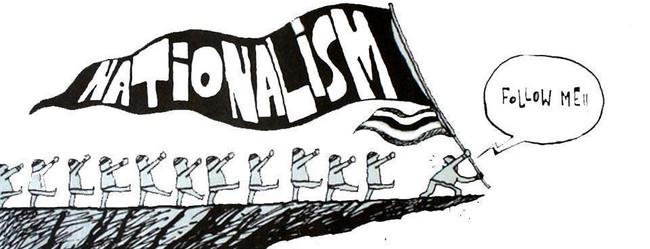
At the same time, history shows very clearly that nationalism can turn destructive when it is taken too far or used by the wrong people for the wrong reasons. Extreme nationalism played a central role in causing both World War I and World War II, as countries pursued aggressive expansion in the name of national glory.
Nationalism in Today’s World:
Nationalism has not disappeared in the modern, globalized world. In fact, in recent years, many countries have seen a rise in nationalist politics. This can be seen in movements pushing for stricter immigration controls, resistance to international organizations, and a general preference for national interests over global cooperation. Supporters argue that this protects local jobs, culture, and security. Critics argue that it can encourage isolation, xenophobia, and weaker responses to global challenges that no single nation can solve alone.
At the same time, globalization has created a strange tension. People are more connected across borders than ever before through trade, travel, and the internet, yet many still feel a strong pull toward protecting a distinct national identity. This tension is likely to remain one of the defining political questions of the twenty-first century.
Conclusion:
Nationalism is neither purely good nor purely bad. It is a powerful idea that has shaped the modern world in enormous ways, from the creation of independent nations to some of the darkest chapters of human history. The real difference lies in how it is used. When nationalism inspires people to build, protect their culture, and support one another, it can be a genuinely positive force. When it is twisted into hatred toward outsiders or used as a tool for aggression and exclusion, it becomes dangerous. Understanding this balance is key to making sense of why nationalism continues to shape politics and society all around the world today.
References:
Anderson, B. (1983). Imagined Communities: Reflections on the Origin and Spread of Nationalism. London: Verso.
Gellner, E. (1983). Nations and Nationalism. Ithaca: Cornell University Press.
Hobsbawm, E. J. (1990). Nations and Nationalism since 1780: Programme, Myth, Reality. Cambridge: Cambridge University Press.
Smith, A. D. (1991). National Identity. London: Penguin Books.
Kohn, H. (1944). The Idea of Nationalism: A Study in Its Origins and Background. New York: Macmillan.

Political Sciences Intern at CFRPSAIL